



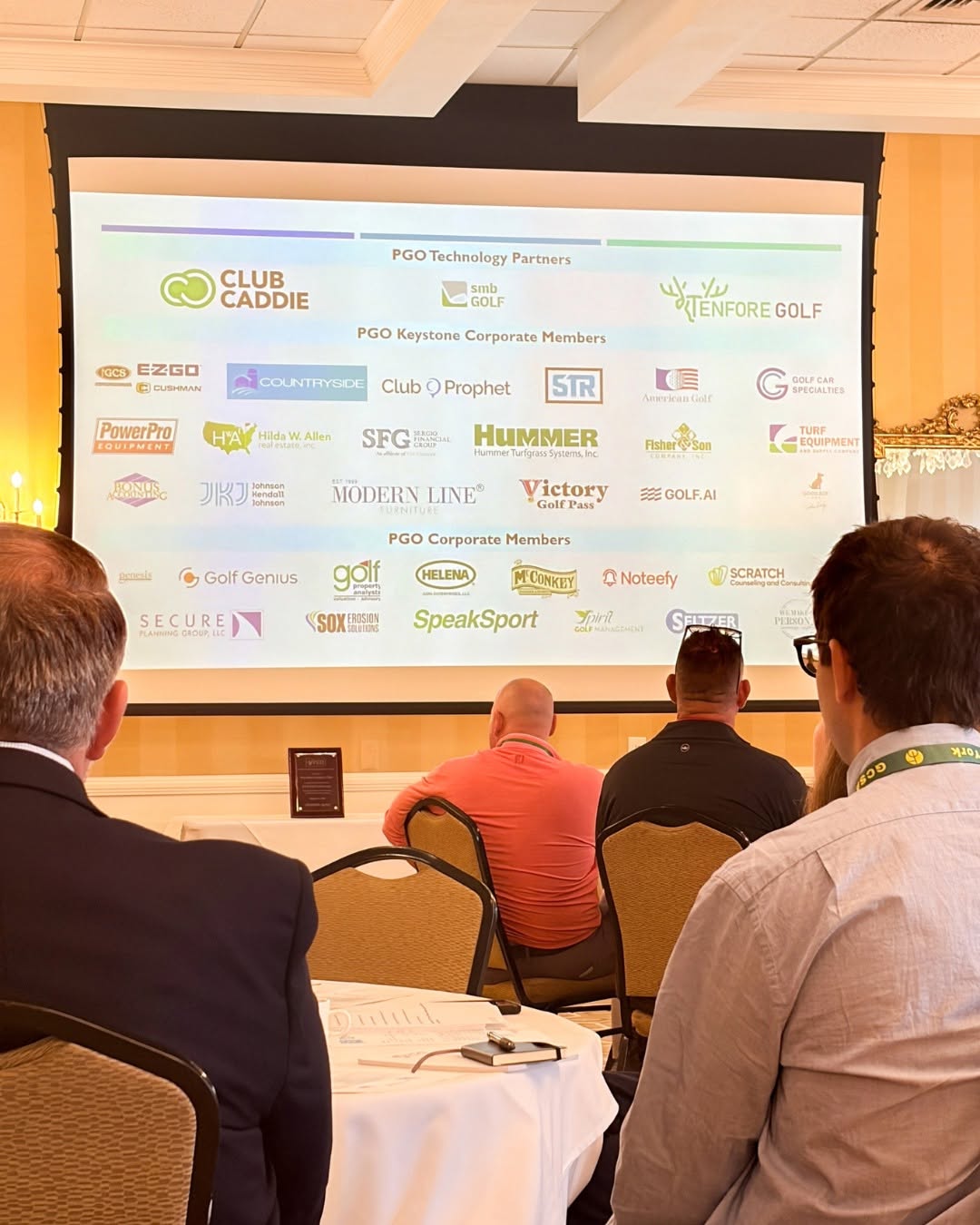

From online tee times and dynamic pricing to artificial intelligence, research shared at the 2026 PGO Fall Conference reveals how golf courses are using technology—and where opportunities remain.
Golf courses have more technology at their fingertips than ever before.
Online reservations, automated waitlists, mobile apps, point-of-sale systems, dynamic pricing, and artificial intelligence are changing how golf facilities operate and serve their customers.
But here’s a question worth asking:
Are golf courses getting more value from all this technology, or are they simply collecting more systems?
That question was at the heart of a Technology & AI Town Hall led by Mike Hendrix, President of smbGOLF and PGO’s Senior Technology & Data Advisor, on Tuesday, October 6, during the October 5–6, 2026 PGO Fall Conference at Out Door Country Club in York, Pennsylvania.
Rather than discussing technology in theory, Hendrix brought research involving 27 golf courses represented at the conference—25 public-access courses and two private clubs.
The findings offered an interesting look at which technologies are being used, how they fit together, and where operators may be missing opportunities to improve revenue, efficiency, and the golfer experience.
The conversation also introduced a challenge for every golf course operator: What could your business accomplish if artificial intelligence helped your existing team get more work done?
Digital Hospitality: Technology Should Make Golf Easier
Before exploring the numbers, it’s worth understanding the philosophy behind the discussion.
Hendrix calls it Digital Hospitality.
For years, the golf industry has focused on delivering hospitality once golfers arrive at the facility. Friendly staff, a welcoming golf shop, excellent course conditions, and a memorable experience remain essential.
But today’s golfer often begins interacting with a course long before arriving at the first tee.
They search Google, compare prices, read reviews, look for available tee times, investigate leagues and outings, and visit a course’s website—often from a mobile phone.
Digital Hospitality applies the same attention to service throughout those interactions.
Can golfers find accurate information? Is booking straightforward? Can they purchase a gift card without calling the golf shop? Does the website reflect what’s happening at the course today?
And behind the scenes, does the technology make employees more productive or create additional work?
The goal isn’t to introduce more technology into golf. It’s to make it easier for golfers to do business with golf courses while helping operators grow revenue and improve their return on technology investments.
That perspective shaped the research and the Town Hall discussion.
1. Online Tee Times Are Everywhere. But Are We Measuring Success?
Perhaps the least surprising finding was how widely online booking technology has been adopted.
All 27 courses had an identified online reservation system, with nine different technology providers represented.
Four providers accounted for 22 of the 27 courses, or approximately 81%:
| Booking technology provider | Courses |
|---|---|
| Tee It Up | 9 |
| Club Prophet | 5 |
| Club Caddie | 4 |
| foreUP | 4 |
Meanwhile, 16 of the 27 courses (59%) were listed on GolfNow, including seven that used a different technology provider for their direct online reservations.
These findings raised some important questions.
How many golf course operators know what percentage of their website visitors actually complete a tee time reservation?
How much online business comes directly through the course’s website compared with third-party marketplaces?
And how much does acquiring each reservation cost?
Having an online booking engine doesn’t automatically mean a golf course has an effective online booking strategy.
A golfer might find a course on Google, visit its website, search available times, and abandon the process before completing a reservation. Unless the course measures that journey, the lost opportunity may go unnoticed.
Third-party marketplaces can help golf courses reach additional customers and sell inventory. Direct bookings can also provide valuable opportunities to develop customer relationships and manage distribution costs.
The key is understanding what each channel contributes to the business.
The takeaway: Don’t just measure how many rounds your booking engine processes. Understand where reservations originate, how effectively visitors convert into customers, and what those reservations are worth.
2. Automated Waitlists, Mobile Apps and Online Sales: Opportunities Remain
Beyond tee times, the research identified several technologies intended to improve convenience and generate additional revenue.
Technology adoption snapshot
| Technology or capability | Documented courses | Share of 27 |
|---|---|---|
| Online reservation system | 27 | 100% |
| GolfNow marketplace listing | 16 | 59% |
| Noteefy automated waitlist | 8 | 30% |
| Current branded mobile app | 5 | 19% |
| Online sales beyond tee times | 9 | 33% |
These findings reflect technology identified through smbGOLF data and additional research. A technology not publicly documented should not be assumed to be absent.
Consider the potential value of an automated waitlist.
A foursome cancels a desirable Saturday morning tee time. Without additional technology or staff intervention, those openings might simply reappear on the tee sheet.
An automated waitlist system can alert interested golfers when suitable availability returns, helping courses recover otherwise unsold inventory.
Eight courses had documented use of Noteefy, a platform designed to support that process.
Online commerce presents another opportunity.
Only nine courses had publicly documented online sales beyond tee times, including products such as gift cards and merchandise.
A golfer interested in purchasing a $200 gift card at 9 p.m. shouldn’t necessarily have to wait until the golf shop opens the following morning.
And while branded mobile apps can be useful, the research identified only five verified, current examples.
Hendrix encouraged operators to look beyond whether they have an app and ask a more meaningful question:
What compelling reason does a golfer have to download it, keep it, and use it?
An app that makes a recurring task easier may deliver real value. One that simply duplicates a website may not.
The best technology isn’t necessarily the newest. It’s the technology that solves a meaningful problem.
3. More Revenue Doesn’t Always Mean Higher Prices
Technology investments are also expanding beyond traditional tee sheets and websites.
The presentation highlighted Toptracer installations at Makefield Highlands and Five Ponds, along with simulator technology at Pine Hills and Fairways.
These investments can help golf facilities serve customers beyond a traditional outdoor round, expand instruction and entertainment opportunities, and generate activity during slower seasons or unfavorable weather.
Another emerging opportunity involves dynamic pricing.
Quail Valley was identified as one confirmed example of a course using Priswing alongside Club Prophet.
Dynamic pricing technology can help golf courses adjust rates based on expected demand, booking patterns, and available inventory.
But Hendrix emphasized an important distinction:
The objective isn’t simply to increase the average selling price of a round. It’s to generate more revenue from the tee times a course has available to sell.
Consider a simplified example.
A course has 24 available player spots during a particular time period.
Selling four spots at $100 each generates $400 in revenue.
Now imagine that the course sells those same four spots at $100, plus four additional spots at $75.
The average selling price declines from $100 to $87.50, but total revenue increases from $400 to $700.
Utilization also improves from approximately 17% to 33%.
That’s an increase in revenue without adding another hour to the operating day.
Of course, pricing decisions must consider demand, customer expectations, costs, and potential effects on other bookings. Discounting alone is not a revenue strategy.
The broader lesson is that golf courses should evaluate pricing technology based on its impact on utilization, total revenue, and profitability—not just the average rate displayed on a report.
Don’t overlook the systems behind the scenes
The research also examined technology integration within the clubhouse.
Thirteen courses were identified as using a shared point-of-sale system between their golf shop and restaurant.
Other facilities had separate arrangements.
Neither approach is necessarily wrong. But operators should understand the consequences of disconnected systems.
How much time does staff spend reconciling reports? Are departments duplicating customer information? Can management easily understand the performance of the entire operation?
Sometimes the greatest technology opportunity isn’t purchasing another system.
It’s eliminating the extra work created by the systems already in place.
4. Artificial Intelligence: What If Your Team Could Get More Done?
Artificial intelligence generated some of the most interesting discussion during the Town Hall.
Rather than focusing on futuristic predictions or debating whether AI will replace employees, Hendrix asked operators to consider a practical question:
What work needs to get done at your golf course that nobody seems to have enough time to do?
For many facilities, the list is substantial.
Financial reporting, sales outreach, marketing, online reviews, website updates, customer communications, employee documentation, and countless administrative responsibilities compete for attention.
Smaller operations often have talented employees wearing multiple hats. Important projects remain unfinished—not necessarily because the staff lacks the expertise, but because there simply aren’t enough hours in the day.
AI has the potential to provide additional capacity in several roles.
- Business Analyst: Help review operating and financial data, identify trends, compare performance, and highlight areas requiring attention.
- Sales Assistant: Research potential golf outings, leagues, corporate customers, and group business opportunities.
- Customer Service Assistant: Prepare personalized responses to online reviews, draft customer communications, and organize inquiries that require follow-up.
- Software Developer: Help create small applications, integrations, or workflow tools designed around a course’s specific needs.
- Administrative Assistant: Help prepare routine documents, organize information, summarize meetings, and improve internal communications.
These examples don’t eliminate the need for employees or professional expertise.
Financial analysis still requires validation. Customer communications need appropriate review. Legal and regulatory questions require qualified guidance. Sensitive business and customer information must be handled carefully.
But AI can help staff prepare work, organize information, and move projects forward.
For a small business that cannot justify adding another full-time employee, that additional capacity could be significant.
And there’s another possibility worth considering.
What happens when a golf course can afford to build technology specifically for its own needs?
5. AI Isn’t Just Something You Use. It Can Help You Build.
One of the more practical examples Hendrix shared was a product developed through his company, smbGOLF.
It’s called Text-to-Web.
The concept addresses a familiar golf course problem: keeping customers informed when conditions change.
Imagine a frost delay on a busy Saturday morning.
Staff are answering phones, communicating with the maintenance team, adjusting tee times, and helping golfers who are already arriving.
Somebody should update the website. Perhaps the Facebook page needs an update, too.
But logging into several systems isn’t necessarily the highest priority for someone managing the situation.
Text-to-Web simplifies the process.
An authorized staff member sends a text message, and the information appears as an alert on the course’s website. The system can also distribute updates to other connected channels, including Facebook and compatible app or AI-agent integrations.
Temporary website alerts automatically expire, helping prevent outdated messages from lingering after conditions change.
The product costs $295 annually.
What made the example especially relevant wasn’t the technology itself.
Hendrix used AI-assisted software development to reduce the effort required to create a relatively inexpensive solution to a common operational problem.
That’s a meaningful shift.
Historically, custom software development could be too costly or complicated for an individual golf facility to consider.
AI-assisted development is making certain kinds of small, focused technology projects more practical.
Not every golf course needs to become a software developer. But operators can increasingly identify recurring problems and explore whether affordable, purpose-built tools might solve them.
The lesson applies far beyond website updates:
Start with the problem, not the technology.
6. A Practical AI Opportunity: Managing Online Reviews
Another example from the presentation addressed something nearly every golf course has in common: online customer reviews.
Reviews influence how golfers perceive a facility, and responding to them is an important part of customer service.
But consistently monitoring Google, Yelp, GolfPass, and other platforms can consume valuable staff time.
Imagine a workflow in which AI helps manage much of the preparation.
The process could:
- Collect new reviews from supported platforms through authorized access.
- Identify reviews that have not received a response.
- Prepare personalized draft responses consistent with the course’s communication style.
- Flag negative reviews and issues requiring management attention.
- Present responses to an employee for review and approval.
- Track completed responses and unresolved concerns.
Instead of spending time repeatedly checking platforms and writing every response from scratch, employees could focus on approving accurate responses and personally addressing important customer issues.
The human element remains essential.
A complaint about an unpleasant customer experience deserves genuine consideration, not an automated apology that nobody at the course has reviewed.
AI may help identify and organize the issue, but the golf course remains responsible for resolving it.
That’s an important distinction.
AI shouldn’t replace hospitality. It should give employees more time to deliver it.
7. The Challenge for PGO Members: Give AI 30 Days
One of the clearest recommendations from the Town Hall was also one of the simplest.
Rather than asking golf course operators to develop a comprehensive AI strategy or make a major technology investment, Hendrix proposed a manageable experiment.
One task. One person. Thirty days. Measure the results.
Choose a responsibility that consumes staff time or regularly gets pushed aside.
Assign someone to experiment with using AI to help complete that work.
Establish a baseline before the experiment begins, review progress weekly, and evaluate the results after 30 days.
For example, a course testing AI-assisted review management might measure:
- How much time employees currently spend monitoring and responding to reviews.
- How long the new process takes, including review and approval.
- How many proposed responses require substantial corrections.
- Whether the course responds more consistently and promptly.
- The total cost of the process, including staff time and software.
At the end of 30 days, operators should be able to answer an important question:
Did this actually make our business better?
If the process saves time, improves service, or reduces costs without sacrificing quality, consider making it permanent.
If it doesn’t, adjust the approach or move on to another opportunity.
The same framework can be applied to financial reporting, marketing, sales prospecting, administrative work, and many other responsibilities.
It’s a low-risk way for golf courses to develop practical experience with artificial intelligence while remaining focused on measurable results.
8. The Future of Golf Course Technology Is About Results
Looking at the 27 courses represented at the conference, one thing is clear: golf facilities are already using a wide range of technology.
Online booking is well established. Automated waitlists, e-commerce, advanced practice technology, dynamic pricing, and artificial intelligence offer additional opportunities.
But adopting technology isn’t the same as benefiting from it.
A sophisticated tee sheet provides limited value if the operator cannot measure booking performance.
An expensive mobile app offers little return if customers have no reason to use it.
An AI assistant isn’t especially useful if it relies on outdated or inaccurate information.
And purchasing new software won’t necessarily solve problems created by poorly connected existing systems.
The challenge is to move beyond asking what technology a golf course has and start asking what that technology accomplishes.
Does it help sell more available inventory?
Does it improve the customer’s experience?
Does it reduce unnecessary work?
Does it generate additional revenue or lower costs?
Can the results be measured?
These are questions every operator can ask, regardless of the size of the facility or its technology budget.
Better Technology. Better Hospitality. Better Business.
Perhaps the most important takeaway from the PGO Technology & AI Town Hall is that golf courses don’t necessarily need more technology.
They need technology that works harder for their customers, their employees, and their businesses.
The opportunity is to connect technology decisions with meaningful operating goals, measure the outcomes, and continually improve.
And with artificial intelligence making new capabilities and custom solutions more accessible, even smaller golf operations can explore ideas that might previously have been out of reach.
The future of golf course operations won’t be determined by how many technology platforms a facility purchases.
It will be determined by how effectively operators use technology to deliver better experiences and stronger business results.
That’s Digital Hospitality in action.
About the Research
The presentation examined 27 golf courses represented at the 2026 PGO Fall Conference, including 25 public-access courses and two private clubs. Findings were developed using smbGOLF data and additional research into the technology used by participating facilities.
Some information reflects identified or reported technology systems, while other findings represent publicly documented examples. Technology that could not be independently identified should not be interpreted as technology a facility does not use.
The findings represent this specific group of courses as researched for the October 2026 presentation and should not be treated as a statistically representative survey of all Pennsylvania golf facilities.
About the Presenter
Mike Hendrix is President of smbGOLF and serves as Senior Technology & Data Advisor to the Pennsylvania Golf Course Owners Association (PGO). His work focuses on Digital Hospitality, golf course technology, data, customer experience, and helping operators grow revenue while improving their return on technology investments.
Keep the Conversation Going
PGO thanks Mike Hendrix for leading an informative and engaging Technology & AI Town Hall at our 2026 Fall Conference.
We encourage members to share their own experiences. What technology has made the biggest difference at your facility? Have you started experimenting with AI? And what operational problem would you most like technology to help solve?
PGO looks forward to continuing these conversations and helping members make smarter technology decisions.